
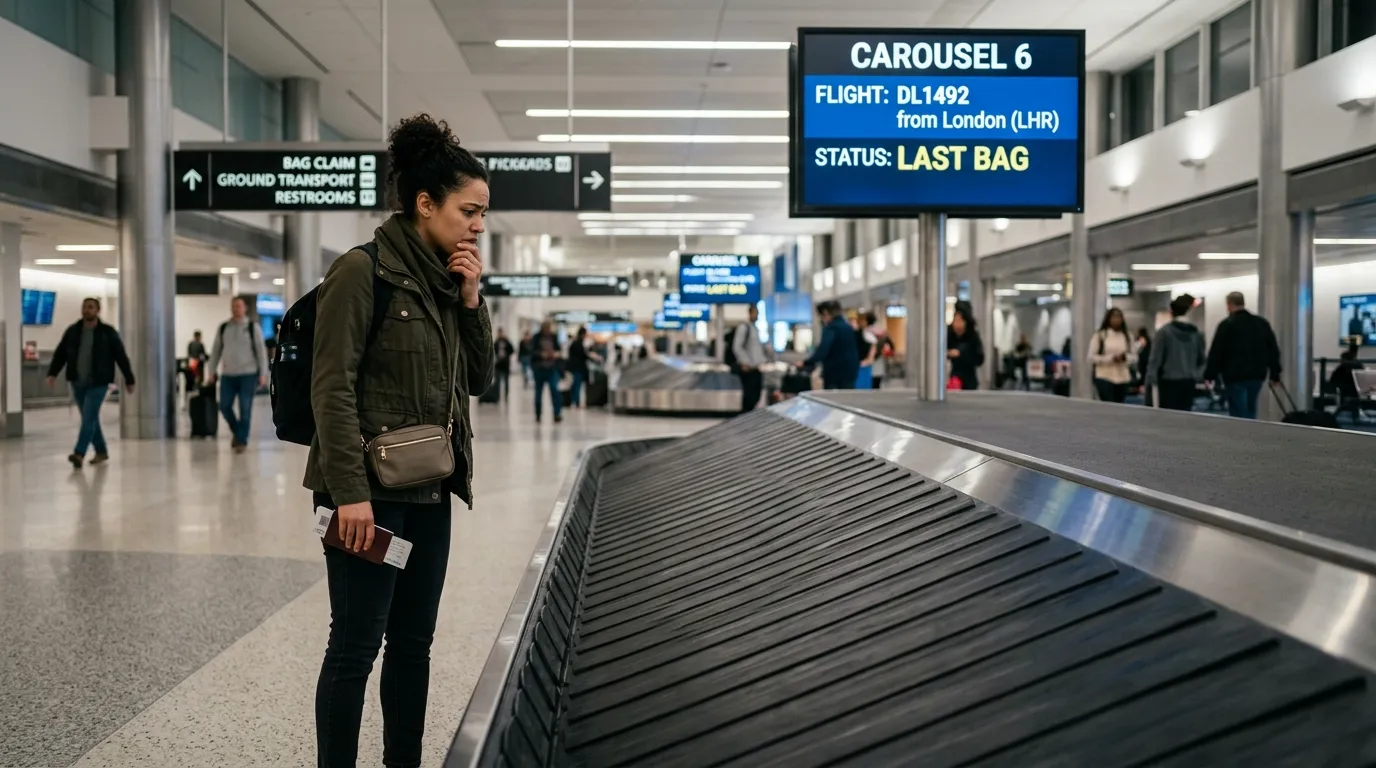

You land after hours in the air. The baggage carousel goes around once, twice, three times — and your bag never appears. Losing your luggage is one of travel’s most stressful moments, but here’s what the airline won’t tell you upfront: lost luggage compensation is your legal right, not a favour they’re doing you.
Airlines mishandle over 26 million bags every year. Whether yours is delayed, damaged, or completely missing, you are entitled to financial compensation under international law — and this guide shows you exactly how to get it.
Step 1: File a Report Before You Leave the Airport
The single biggest mistake travellers make is going home and hoping the bag turns up. Don’t do this.
Before you leave the baggage claim area, go directly to the airline’s baggage services desk and file a Property Irregularity Report (PIR). This official document is the starting point for any lost luggage compensation claim. Without it, your claim becomes very difficult to pursue.
What to Include in Your PIR
- Full name and contact details
- Flight number and booking reference
- Detailed bag description — colour, brand, size, any stickers or identifiers
- Contents list as best you can recall (important for valuation)
- Delivery address (hotel or home)
Get a copy of the PIR and write down your file reference number — you’ll need it for tracking and for your compensation claim.
Quick tip: Also keep your boarding pass and baggage claim stub. These are your proof that the bag was checked in and under the airline’s responsibility.
Step 2: How to Track Your Missing Bag
Once your PIR is filed, tracking your bag is easier than most people realise.
Use the WorldTracer System
Most major airlines use WorldTracer, a global baggage tracing network operated by SITA. When you file a PIR, your missing bag is entered into this system and matched against unclaimed baggage at airports worldwide.
You can track your bag at:
- Your airline’s dedicated baggage tracking page
- The WorldTracer public portal: worldtracer.aero
Updates usually appear within 24 hours of filing.
Check Your Connecting Airport First
The most common cause of delayed bags is a missed connection — especially if your layover was short or your first flight ran late. Your bag usually shows up at the transit airport and is forwarded within 24–48 hours.
Call the baggage services desk at your layover airport directly if the online tracker isn’t showing updates.
Contact the Airline Every 24 Hours
Don’t wait passively. Call or message the airline’s baggage team daily for updates. Ask:
- Has the bag been found in WorldTracer?
- Which airport is it at?
- What is the confirmed delivery window?
Log every call — the date, agent’s name, and what they said. This log is evidence if you need to escalate your lost luggage compensation claim later. Often, bags go missing because of a late-running or cancelled flight that disrupts the baggage transfer process.
Step 3: Delayed vs Lost vs Damaged — Know the Difference
Understanding which category applies to your situation determines what lost luggage compensation you can claim.
Delayed luggage — The airline knows where it is and is returning it. Most “missing” bags fall here and are returned within a few days. You can still claim essential expenses during the wait.
Lost luggage — Under the Montreal Convention, a bag is officially lost after 21 days from the date of reporting. Once past this threshold, you can claim full compensation for the bag and all contents.
Damaged luggage — Your bag arrived but was physically damaged in transit. Report this before leaving the airport, or within 7 days under international rules. You can claim repair or replacement costs.
Each category has its own compensation path — but all three start with a filed PIR.
Step 4: Lost Luggage Compensation Rules by Country
Lost luggage compensation varies by country and the type of flight you were on. Here’s what the rules say in the key regions.
The Montreal Convention — Global Baseline for International Flights
The Montreal Convention of 1999 is the international treaty governing baggage claims on most cross-border flights. It has been ratified by over 130 countries, including the US, UK, all EU member states, Canada, and Australia.
Under this treaty, airline liability for lost, damaged, or delayed baggage is capped at approximately 1,288 Special Drawing Rights (SDRs) per passenger — roughly $1,700 USD / £1,350 GBP / €1,600 EUR.
You can exceed this limit by declaring a higher baggage value at check-in and paying the additional fee.
Learn more about passenger rights under the Montreal Convention at the ICAO official website
United States
For domestic US flights, the Department of Transportation (DOT) sets a higher liability limit of $3,800 per passenger. For international flights, the Montreal Convention limit applies.
US airlines are also required to refund checked baggage fees if they lose your bag entirely — many passengers miss this entitlement.
Check your rights at the DOT Aviation Consumer Protection page
United Kingdom
The UK applies its post-Brexit equivalent of EU rules. The Montreal Convention governs international flights, and passengers can escalate unresolved claims to the Civil Aviation Authority (CAA) or an approved ADR scheme.
More details at Civil Aviation Authority — Baggage Rights
European Union (Germany, France, Spain, & All EU Member States)
EU passengers are protected by both the Montreal Convention and EU Regulation 261/2004, which provides additional rights for assistance and reimbursement of expenses during delays. All EU member states — including Germany, France, and Spain — follow these rules.
Canada
The Air Passenger Protection Regulations cover domestic Canadian flights, with airlines required to compensate passengers for lost baggage and refund baggage fees. International routes fall under the Montreal Convention.
Australia
For international flights, Australia follows the Montreal Convention. Domestic passengers are protected under Australian Consumer Law, enforced by the ACCC. Individual airline conditions of carriage also apply.
Step 5: How to Claim Lost Luggage Compensation Step by Step
1. Gather Your Evidence
Before filing, pull together:
- Your PIR reference number
- Boarding pass and baggage claim stub
- All receipts for essential expenses
- A detailed, itemised list of bag contents with estimated values
- Photos of any damage
- Proof of purchase for high-value items, if available
2. Submit a Written Claim to the Airline
Most airlines have an online claim portal — use it for a built-in paper trail. Send your claim by email too, with all documents attached.
Be clear and specific. Reference the Montreal Convention or relevant local regulation. State the compensation amount you’re seeking and why.
3. Value Your Contents Fairly — Don’t Undersell
Airlines typically pay depreciated value for lost items, not replacement cost. But you can push back on unreasonably low valuations.
List everything: clothing by type and brand, electronics with model numbers, toiletries, shoes, books, chargers — anything that was in the bag. A thorough, credible list carries significant weight in a claim.
4. Escalate If the Airline Refuses or Delays
If the airline rejects your claim or goes quiet, escalate:
- US: DOT Aviation Consumer Protection Division
- UK: Civil Aviation Authority (CAA) or CEDR dispute resolution
- EU: Your national civil aviation authority or an ADR scheme
- Canada: Canadian Transportation Agency
- Australia: ACCC or airline internal dispute process, then external escalation
Small claims court is also surprisingly effective in the US and UK. Airlines frequently settle rather than appear in court for modest claim amounts.
Step 6: Essential Expenses You Can Claim During a Delay
While waiting for a delayed bag, you don’t have to go without. Airlines are required to reimburse reasonable essential expenses, which typically include:
- Basic clothing — underwear, a change of clothes, not a full wardrobe
- Toiletries and personal hygiene products
- The medication that was packed in the missing bag
- Necessary chargers or travel accessories
Always ask the airline upfront what their daily reimbursement limit is. Common ranges are $50–$150 USD per day, depending on the airline. Keep every receipt — without them, you cannot claim.
Luxury purchases won’t be covered. Stick to genuine essentials, and you’ll get reimbursed without issue. While dealing with baggage delays at the airport, stay alert for dangerous travel scams that target stressed passengers.
Step 7: Travel Insurance and Lost Luggage — What’s Covered
Travel insurance can significantly top up what the airline pays, and often more generously. Most comprehensive policies include baggage loss and delay cover that offers:
- Replacement value (not just depreciated value) for lost items
- Higher daily allowances during a delay than most airlines offer
- Coverage for high-value items like cameras, laptops, and jewellery (usually declared separately)
Key points to remember:
- You must still file a PIR — insurers require it as proof of reported loss
- You can claim from both the airline and insurance for different losses, but not the same cost twice
- Many premium credit cards in the US, UK, Canada, and Australia include automatic baggage protection when you book travel with that card — check your card benefits before purchasing separate insurance
File your insurance claim as soon as possible. Policies have strict time windows, and delay can invalidate your claim.
FAQ: Lost Luggage Compensation Questions Answered
Q: How long before luggage is officially declared lost?
Under the Montreal Convention, baggage is officially declared lost after 21 days from the date it was reported missing. Before that, it’s classified as delayed. Once the 21-day mark passes, you can file a full lost luggage compensation claim.
Q: Can I get lost luggage compensation on an international flight?
Yes. The Montreal Convention applies to virtually all international flights and provides a compensation cap of approximately 1,288 SDRs (around $1,700 USD). If your losses exceed this, travel insurance or a declared higher value at check-in can bridge the gap.
Q: The airline is offering me a very low settlement — do I have to accept it?
No. You are not obligated to accept the first offer. Counter with your itemised contents list and supporting evidence. If the airline won’t negotiate, escalate to your national aviation authority or consider small claims court.
Q: Can I get my baggage fee refunded if my bag is lost?
In the United States, yes — the DOT requires airlines to refund checked baggage fees for lost bags. In other countries, this depends on the airline’s policy, but it’s always worth requesting as part of your overall lost luggage compensation claim.
Q: What if my bag is lost on a connecting flight with two different airlines?
If you booked as a single itinerary, the last operating carrier is generally responsible. File your PIR with the airline that operated your final flight. They will coordinate with the other carriers — that’s not your problem to untangle. If the flights were booked separately, you may need to identify which leg the bag was lost on and claim against that specific airline.
Final Thoughts: Your Bag May Be Gone, But Your Rights Aren’t
Lost luggage compensation is not a lottery. It’s a legal entitlement backed by international law, and the process — while sometimes slow — works when you follow it correctly.
Your 7-step action plan:
- File a PIR at the baggage desk before leaving the airport
- Track your bag via WorldTracer and call the airline every 24 hours
- Identify whether your bag is delayed, lost, or damaged
- Know the rules that apply to your route and country
- Submit a detailed written claim with all documentation and receipts
- Claim essential expenses separately — keep every receipt
- Escalate to regulators or small claims court if the airline refuses
Most delayed bags do come back. But whether yours does or not, you have a clear, structured path to get back what you’re owed. Start at the baggage desk, document everything, and don’t accept a low offer without pushing back.
Disclaimer: This article provides general guidance based on international regulations current at the time of writing. Rules and compensation limits vary by airline, route, and jurisdiction. For high-value claims or complex situations, consult a consumer rights specialist.