
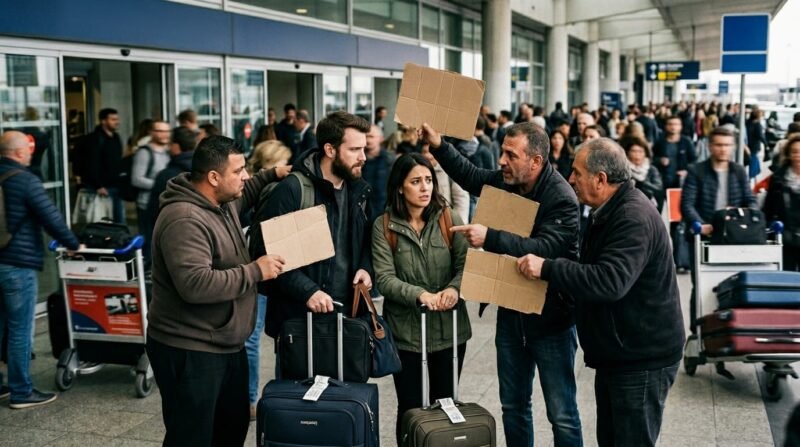

Dangerous Travel Scams targeting tourists are nothing new, but they’ve gotten sharper, faster, and far more convincing in recent years. The US Federal Trade Commission reported $274 million in travel fraud losses by American consumers in 2024 alone. British holidaymakers aren’t doing much better — scammers cost UK tourists an estimated £1,380 per victim on average. And Booking.com’s own safety chief reported a jaw-dropping 500% to 900% spike in travel scams over just 18 months, driven largely by AI-powered fraud.
The frustrating thing? Most victims say the same thing afterwards: “I knew it seemed off, but I didn’t want to be rude.”
This guide covers the 10 most common and costly travel scams specifically designed to catch Americans and British tourists off guard — how each one works, where it happens, and what to do about it.
Scam 1: The Fake Taxi — Most Dangerous Travel Scams at Any Airport
Where it happens most: Airports in Rome, Bangkok, Cairo, Istanbul, Cancún, and Marrakech. Also common outside major train stations across Europe and Asia.
How the scam works:
You step out of arrivals, jet-lagged and loaded with luggage, and someone in a semi-official-looking jacket approaches you. “Taxi? Good price, no waiting.” Before you know it, you’re in an unmarked car with no meter, and by the time you reach your hotel, you’re being charged five times the normal fare.
Some variants are even more calculated. The driver takes a deliberately longer route. Others claim the meter is “broken” and quote an inflated fixed rate. In more extreme cases — particularly in certain parts of Southeast Asia and North Africa — tourists have been driven to secluded locations and robbed outright.
This is one of the most consistent travel scams targeting American and British tourists simply because both nationalities tend to avoid confrontation. They pay up rather than cause a scene.
How to avoid it:
- Scammers often target people who are already stressed due to a sudden flight cancellation, knowing they are desperate to reach their hotel quickly.
- Use official taxi ranks at airports, clearly marked with signage
- Book your transfer in advance through your hotel or a trusted app like Uber, Bolt, or Grab (where available)
- Research the typical taxi fare to your destination before you land
- Never get into an unmarked car, no matter how polished the sales pitch sounds
- In the US State Department’s own words: arrange transport through your hotel — it’s the safest option
US travellers: Report taxi fraud to the local tourism police or through the FTC complaint portal when you return. UK travellers: Report incidents to Action Fraud and your travel insurance provider.
Scam 2: The Free Bracelet (and Very Aggressive Demand)
Where it happens most: Paris (Sacré-Cœur and the Eiffel Tower), Barcelona’s La Rambla, Rome, Athens, and London’s South Bank.
How the scam works:
A friendly stranger — sometimes several working as a team — approaches you with a colourful bracelet or a small “gift.” They insist it’s free. They might tie it around your wrist before you’ve even agreed. The moment it’s on, the friendliness evaporates. Now you owe them. Demands for €10, €20, even €50 follow. Refusal is met with shouting, grabbing, or a crowd forming to intimidate you.
This scam surged dramatically across Europe in the summer of 2024 and continues to catch tourists off guard precisely because it weaponises politeness. Americans and British tourists, who are culturally conditioned not to make scenes, are prime targets.
How to avoid it:
- Never accept anything from a stranger on the street — flowers, bracelets, rosemary sprigs, anything
- Keep your hands in your pockets when walking through crowded tourist areas
- If someone approaches and persists, say a firm “No, thank you” and walk purposefully away without slowing down
- Don’t feel guilty — the “gift” was never free, and there is no social obligation here
Scam 3: The Accidental Spill and Pickpocket Setup
Where it happens most: Heavily touristed areas in Paris, Barcelona, Florence, Prague, and Istanbul. Also reported near major landmarks in New York and London.
How the scam works:
This is a team effort. One person bumps into you and “accidentally” spills something — ketchup, ice cream, pigeon droppings (sometimes real, sometimes from a bottle). They’re immediately apologetic and begin helping you clean up. Meanwhile, their partner — standing close behind or to the side — quietly removes your phone, wallet, or passport while you’re distracted.
The US State Department specifically warns Americans about this scam and lists it as one of the most widely used tactics in Europe. The whole thing takes about 15 seconds.
A variation involves someone pointing at a stain already on your jacket that you “didn’t notice.” The goal is the same: get your hands moving and your attention divided.
How to avoid it:
- If someone insists on helping you clean up unexpectedly, immediately put both hands in your pockets and valuables
- Wear a money belt under your clothing for your passport and spare cash
- Keep your bag in front of you — not on your back — in crowded areas
- Use cross-body bags with secure zips rather than open-top totes or backpacks
Scam 4: ATM Skimming and Card Cloning
Where it happens most: Tourist-area ATMs in Mexico, Eastern Europe, Southeast Asia, and popular beach resorts. Also reported in major Western cities.
How the scam works:
A tiny device — called a skimmer — is fitted over the card slot of a legitimate ATM. It reads and stores your card details as you insert it. A small pinhole camera, often disguised as part of the machine or mounted nearby, captures your PIN. Within hours, a duplicate card is made, and your account is drained.
This scam is particularly damaging for American and British tourists because it happens silently. You use the ATM, get your cash, walk away — and have no idea anything went wrong until you check your balance later.
There’s also a newer digital version: scammers use RFID readers to wirelessly steal contactless card data from people standing nearby in queues, on public transport, or in crowded tourist spots.
How to avoid it:
- Always use ATMs attached to a bank branch — avoid standalone machines in tourist shops or dark corners
- Before inserting your card, give the card slot a firm wiggle — skimmers are glued on and will feel loose
- Cover the keypad with your hand when entering your PIN — this defeats the hidden camera
- Use a travel card with instant transaction alerts, so you’re notified immediately of any unauthorised use
- Consider an RFID-blocking wallet or sleeve for your cards — they’re inexpensive and widely available
Scam 5: Fake Police Officers Demanding to See Your Wallet
Where it happens most: Prague, Bangkok, Cancún, and parts of South America. Also occasionally reported in Southern European cities.
How the scam works:
Two people approach you — one in plain clothes, one wearing what looks like a police uniform (or flashing a convincing-looking badge). They tell you there’s been counterfeit currency in the area and ask to inspect your wallet to check your notes. Some variants claim to be investigating drug money.
If you hand over your wallet — which many tourists do because they’re nervous and want to cooperate — notes go missing before it’s returned. In some cases, tourists are told their money is “suspicious” and asked to accompany the officers to a vehicle or “police station.”
The FCDO (Foreign, Commonwealth & Development Office) in the UK has issued repeated warnings about this scam, and it’s listed prominently on the US State Department’s travel scam advisory page.
How to avoid it:
- Real police officers never ask to inspect your wallet on the street
- If approached, do not hand over your wallet or passport
- Offer to walk with them to the nearest official police station — legitimate officers won’t object; scammers will scatter
- Ask for the officer’s badge number and write it down in front of them
- Check FCDO travel advisories before every trip for country-specific scam warnings
Scam 6: “Your Hotel Is Closed” — The Redirect Scam
Where it happens most: Marrakech, Cairo, Istanbul, and parts of India and Southeast Asia.
How the scam works:
Your taxi driver pulls up near your hotel and announces, with apparent sincerity, that it’s been closed — a fire, a flood, a sudden shutdown. He happens to know a much better place nearby, at the same price, very comfortable. He takes you there. The “hotel” turns out to be a relative’s guesthouse, charging double, with the driver pocketing a commission.
Which? Travel’s Jo Rhodes experienced exactly this in Marrakech. The driver was convincing, the story plausible, and only checking the hotel’s phone number directly prevented her from being redirected.
This is a well-worn scam that’s been running for decades, but it still catches thousands of tourists every year — particularly first-time visitors who don’t know the area.
How to avoid it:
- Before arriving, save your hotel’s direct phone number in your phone
- If a driver makes this claim, call the hotel yourself — right then, in the taxi
- Have your booking confirmation screenshot saved offline so you can verify the address yourself
- Use Google Maps to navigate and check if the driver is actually heading to your destination
Scam 7: Fake Booking Websites and Phantom Rentals
Where it happens most: Everywhere — this is an online scam that targets you before you even leave home. Spikes significantly during peak travel seasons.
How the scam works:
You search for a holiday villa, a budget hotel, or cheap flights online and find a website that looks completely legitimate — professional design, customer reviews, a real-looking phone number. You book and pay. Then nothing. The “property” doesn’t exist, the flights were never real, and the website has vanished.
The US Joint Economic Committee reported that travel fraud costs Americans over $274 million in 2024, with fake booking sites being one of the primary methods. Booking.com reported a 500–900% increase in scam attempts over just 18 months, much of it AI-generated.
British consumers face the same threat. The BBB issued multiple warnings in 2025 about fake travel agencies operating through social media ads and unsolicited emails — often advertising “exclusive deals” that vanish the moment payment is made.
How to avoid it:
- Book directly through airline and hotel websites, or use well-established platforms like Booking.com, Expedia, or Hotels.com — and verify the URL carefully
- Check that the website URL uses HTTPS and that the domain name is exactly right — scam sites often use one transposed letter (e.g., “Booking. corn” instead of “.com”)
- Pay by credit card — it offers the best fraud protection and chargeback rights
- Check the Better Business Bureau or TrustPilot for reviews before booking any unfamiliar travel service
- If a deal looks too good to be true, it is
Scam 8: Shortchanging at Shops and Currency Exchanges
Where it happens most: Markets, small shops, street food stalls, and unlicensed currency exchange kiosks across Europe, Asia, and North Africa.
How the scam works:
You hand over a large note — say a €50 or $50 bill — and the vendor counts your change back slowly, deliberately pausing, using fast hand movements or distracting conversation to shortchange you by €10 or €20. By the time you notice, you’re halfway down the street.
A particularly crafty version involves swapping your large note for a smaller denomination when you’re not watching, then claiming you only handed over €10 when you gave €50.
Which? Magazine’s travel editor Rory Boland nearly fell for a variant of this at Warsaw airport — a man claiming to be exchanging leftover UK coins for notes handed over fake £1 coins that felt almost identical to real ones.
How to avoid it:
- Count your change immediately and in full before moving away from any counter
- Familiarise yourself with local currency denominations before you land — download an image for reference
- Never exchange money at unofficial kiosks or with strangers on the street
- Hand over the exact amount wherever possible to avoid the “I don’t have change” follow-up pressure
- At markets, agree on a price before handling any goods or handing over money
Scam 9: The Petition and Clipboard Distraction Con
Where it happens most: Outside the Louvre and Eiffel Tower in Paris, near the Colosseum in Rome, and in London around Covent Garden, Leicester Square, and Trafalgar Square.
How the scam works:
A group — often young people, sometimes children — approaches you with a clipboard and a petition about a supposedly important cause: deaf children, homeless animals, a local charity. They’re polite, they speak some English, and the request seems harmless. As you sign or consider donating, their partners work the crowd around you.
Your phone disappears from your pocket. Your wallet is lifted from your open bag. In some cases, people have had sunglasses removed from the top of their heads.
This scam is so effective because it hijacks two instincts that American and British tourists typically have in abundance: politeness and charitable impulse.
How to avoid it:
- Don’t stop walking for anyone with a clipboard in a tourist area — you can support causes through verified charities when you’re home
- Keep your phone in a front zipped pocket, never loose in a jacket or open bag
- If you are stopped, keep one hand firmly on your bag at all times
- A firm “no” and continuing to walk is not rude — it’s just smart
Scam 10: Free Public Wi-Fi and Digital Pickpocketing
Where it happens most: Airports, cafes, hotels, and popular tourist areas globally. Increasingly common across Europe, Asia, and the Middle East.
How the scam works:
You spot free Wi-Fi at the airport or near a landmark. You connect. What you don’t know is that this network was set up by a scammer sitting nearby with a laptop. Every login, every password, every card number you enter on that connection is captured.
A more passive version is RFID theft — criminals use handheld readers to wirelessly steal data from contactless payment cards in your wallet or pocket while standing next to you in a queue or on a bus. It requires no contact and takes under a second.
Travel fraud has become a trillion-dollar global criminal industry, and digital scams are the fastest-growing segment of it. This is no longer just a concern for tech-savvy travellers — it affects anyone with a smartphone or a contactless card.
How to avoid it:
- Digital theft is a major risk, but losing your physical bags is just as common. If your luggage doesn’t arrive, follow these 7 proven steps to track your bag to get compensated.
- Never use unsecured public Wi-Fi for banking, email logins, or any transaction involving a password
- Use a VPN (Virtual Private Network) when connecting to any public network abroad — apps like ExpressVPN or NordVPN are easy to set up before your trip
- Verify the exact Wi-Fi network name with staff before connecting in cafes, hotels, and airports
- Use an RFID-blocking wallet or card sleeve — they’re under $15 and genuinely effective
- Turn off auto-connect on your phone so it doesn’t join unknown networks automatically
General Safety Tips for American and British Tourists Abroad
Knowing specific scams is half the battle. Here are the habits that protect you from all of them:
Before you leave:
- Register your trip with your government’s travel programme. Americans can use the Smart Traveller Enrollment Program (STEP) through the US State Department. British travellers should check the FCDO travel advice for their destination.
- Save the address and phone number of your nearest embassy or consulate offline.
- Make digital copies of your passport, travel insurance, and booking confirmations — store them in cloud storage you can access without Wi-Fi.
- Tell your bank you’re travelling, so legitimate card use abroad doesn’t get flagged and blocked.
- If London is on your list, read our complete guide on how to find cheap flights to London from the USA before you book — most travelers overpay by hundreds of dollars.
While you’re there:
- Trust your gut. If an interaction doesn’t feel right, you’re allowed to walk away without explanation.
- Keep your most important documents (passport, backup card) in a money belt under your clothing.
- Avoid looking lost in busy areas — step into a shop or cafe to check your map rather than standing on a corner with your phone out.
- Be especially careful in the first 24 hours. Jet lag, unfamiliar surroundings, and the general excitement of arrival make you significantly more vulnerable.
If you’re targeted:
- Don’t chase anyone who takes something — prioritise your own safety.
- Report the incident to the local tourist police immediately and get a crime reference number for your insurance claim.
- Contact your bank immediately if cards are lost or compromised — most will cancel and reissue within 24 hours.
- Americans can report fraud at reportfraud.ftc.gov. British travellers should contact Action Fraud
FAQ: Travel Scams Targeting American and British Tourists
Q: Which countries have the worst travel scams for American and British tourists?
Rome, Paris, and Barcelona consistently top the list in Europe. Outside Europe, Bangkok, Marrakech, Cairo, and parts of Mexico — particularly Cancún and Mexico City — see frequent reports. That said, no destination is entirely scam-free, including popular cities in the US and UK themselves. The level of risk depends far more on the specific area and how prepared you are than on the country as a whole.
Q: Are travel scams getting worse in 2025?
Yes. Booking.com’s internet safety team reported scam attempts rising between 500% and 900% over 18 months through 2024–2025, largely driven by AI tools being used to create more convincing fake websites, emails, and even voice calls. Digital and online scams are growing the fastest, but street-level scams remain as prevalent as ever.
Q: What should I do immediately if I’ve been scammed while travelling?
Stay calm and don’t put yourself in danger by pursuing anyone. Report the incident to the local tourist police and get a written crime report — your travel insurer requires this. Contact your bank immediately if your card or account is involved. Back home, Americans should file a report at reportfraud.ftc.gov, while British travellers should contact Action Fraud.
Q: Does travel insurance cover scams?
It depends on the policy and the type of scam. Most comprehensive travel insurance covers theft of belongings (including phones and wallets), but fraud — where you voluntarily handed over money under false pretences — is often harder to claim on. Always read the policy carefully before travelling. Credit card companies often offer stronger protection for fraudulent transactions.
Q: Is it safe to use ATMs abroad at all?
Yes, with sensible precautions. Use ATMs attached to a bank branch rather than standalone machines. Cover the keypad when entering your PIN. Avoid ATMs that look physically tampered with — a loose or unusual card slot is a red flag. Set up instant transaction alerts on your card so you know immediately if something unauthorised goes through.
Final Word: The Best Defence Is a Confident Tourist
The truth about travel scams targeting American and British tourists is this: scammers are professional at what they do. They’ve run their routines thousands of times. They know exactly how to catch you off-guard, how to use politeness against you, and how to make the whole thing feel normal until it’s too late.
But here’s the flip side: almost every scam on this list becomes nearly impossible to pull off the moment you know it exists. The bracelet loses its power when you keep your hands in your pockets. The fake taxi goes nowhere when you’ve pre-booked your transfer. The spill routine fails the moment you cover your pockets first.
Stay informed, stay alert — and don’t let the fear of scams keep you from enjoying one of the world’s genuinely wonderful experiences: exploring somewhere completely new.
This article reflects scam trends and advice as of 2026. Laws and reporting channels may change. Always consult your government’s official travel advisory page before international travel.