
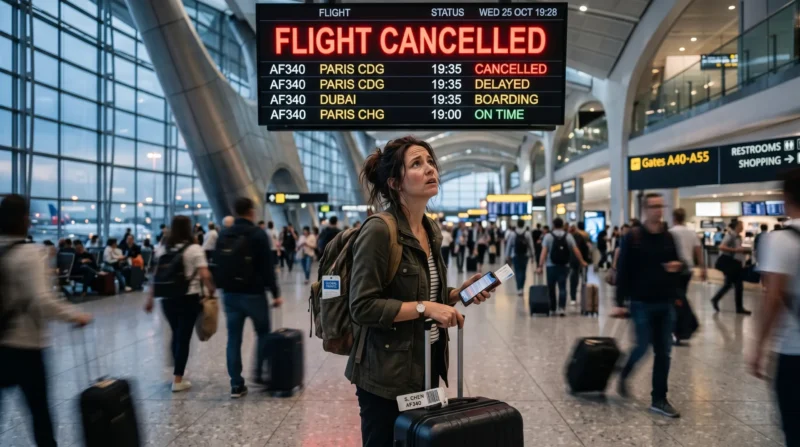

There’s a moment every traveller dreads: you’re at the gate, bag in hand, ready to go — and the departure board flips to FLIGHT CANCELLED. Your stomach drops. Your plans unravel. And almost immediately, the questions start piling up: Will I get my money back? Can I actually claim flight cancellation compensation? Does the reason even matter? Understanding your global passenger rights is the only way to ensure you don’t get intimidated by complex airline policies.
The good news is that you have more rights than most airlines want you to know about. Whether you’re stranded in Chicago, London, Paris, or Sydney, this guide walks you through exactly what to do when your flight is cancelled — step by step — and how to claim every dollar, pound, or euro you’re legally entitled to.
Step 1: Don’t Leave the Airport Without Doing These Things First
The first 30 minutes after a cancellation are the most important. Before you do anything else, here’s what to focus on:
Get Everything in Writing
Ask the airline representative at the gate or customer service desk for a written explanation of the cancellation. The reason matters — legally. If the airline cancels due to a reason within their control (mechanical failure, staffing issues, commercial decisions), your compensation rights are much stronger. If it’s weather or air traffic control, the rules shift.
Take photos of the departure board showing the cancellation. Screenshot any texts or app notifications from the airline. This paper trail matters when you file a claim later.
Know Your Immediate Entitlements
Regardless of the reason for cancellation, most airlines are required by law to offer you one of the following:
- A full refund to the original payment method
- Rebooking on the next available flight to your destination (at no extra charge)
- Re-routing via an alternative carrier or route
In the US, UK, EU, Canada, and Australia, airlines must also provide meals, refreshments, and accommodation if you’re delayed overnight due to a cancellation — though the specifics vary by region (more on that below).
Pro tip: Don’t accept a travel voucher as your only option unless you genuinely want one. In most jurisdictions, you are entitled to a cash refund if you prefer it.
Step 2: Understand What Compensation You’re Actually Owed
Determining your eligibility for flight cancellation compensation is the first step toward recovering your money. This is where things get interesting — and where most passengers leave money on the table. Compensation rules depend heavily on where you’re flying and which airline you’re using.
EU Flight Compensation Rules (EC 261/2004)
If your flight departs from an EU airport, or arrives at one on an EU-based carrier, you’re protected by one of the strongest passenger rights laws in the world: EU Regulation 261/2004.
Under this regulation, you may be entitled to between €250 and €600 per person in compensation, depending on the flight distance:
| Flight Distance | Compensation |
|---|---|
| Under 1,500 km | €250 |
| 1,500–3,500 km | €400 |
| Over 3,500 km | €600 |
This applies when the airline cancels with less than 14 days’ notice. If you received notice between 7 and 14 days before departure and were offered an alternative flight that gets you there within a few hours of your original arrival time, the compensation may be reduced by 50%.
Important: EU261 does not apply if the cancellation was caused by “extraordinary circumstances” — meaning things genuinely outside the airline’s control, like severe weather, political instability, or major security threats. Airlines sometimes overuse this exemption, so don’t just take their word for it.
This regulation also applies to the UK (as UK261 post-Brexit), with the same compensation amounts in British pounds.
US Flight Cancellation Rights
Passenger rights in the United States work differently. The US does not have a fixed compensation amount for cancellations, the way the EU does. However, the Department of Transportation (DOT) has rules that require airlines to:
- Provide a full cash refund if the airline cancels your flight, regardless of the reason
- Offer a refund even if you have a non-refundable ticket
- Not just issue travel credits without your consent
In May 2024, the Department of Transportation (DOT) significantly strengthened these rules, requiring airlines to issue automatic refunds within 7 business days (for credit card payments) without passengers needing to request them. If your airline cancelled and hasn’t refunded you automatically, you are entitled to demand one. In the United States, the extent of airline liability is strictly governed by the DOT, ensuring that passengers are not forced to accept travel vouchers instead of cash.”
Many US airlines also have what are called “customer service commitments” — rebooking on partner airlines, hotel accommodation, and meal vouchers — though these are voluntary rather than legally mandated in the same way.
Canada, Australia, and Other Countries
Canada introduced its Air Passenger Protection Regulations in 2019, which set out compensation of CAD $125–$1,000 depending on flight length and delay caused by the airline. Cancellations within the airline’s control entitle passengers to compensation and rebooking or refund options.
Australia operates under the Australian Consumer Law and individual airline conditions of carriage. There’s no single federal compensation amount, but airlines are required to offer refunds or alternative travel for cancellations — and the ACCC enforces consumer protection rights against misleading conduct.
Germany, France, and Spain, as EU member states, fall under EU261 protections described above.
Step 3: How to Claim Flight Cancelled Compensation — Step by Step
The process to successfully claim flight cancellation compensation requires clear documentation and persistence with the airline. Knowing your rights is one thing. Actually claiming what you’re owed is another. Here’s how to do it efficiently.
1. Submit a Formal Claim to the Airline First
Always go directly to the airline before involving anyone else. Most airlines have an online claims portal. Find it on their website, fill in your booking reference, flight details, and a clear description of what happened. Attach your evidence (booking confirmation, cancellation notice screenshots, receipts for any expenses).
Set a reasonable expectation: airlines are required to respond within a set timeframe in most jurisdictions (14 days in the EU, for example). Be clear and factual in your claim — no need for emotional language, just the facts and the specific regulation or policy you’re invoking.
2. Follow Up If You’re Ignored or Refused
Airlines sometimes reject legitimate claims, bank on passengers giving up, or issue boilerplate denials citing “extraordinary circumstances” without explanation. Don’t accept a refusal at face value. Ask them to provide written evidence that the cancellation was caused by extraordinary circumstances.
3. Escalate to a Regulator or Ombudsman
If the airline refuses or doesn’t respond:
- EU/UK: File a complaint with your national civil aviation authority (e.g., CAA in the UK, DGAC in France, Luftfahrt-Bundesamt in Germany) or use an Alternative Dispute Resolution (ADR) scheme.
- US: File a complaint with the DOT Aviation Consumer Protection Division at airconsumer.dot.gov.
- Canada: Contact the Canadian Transportation Agency (CTA).
- Australia: Lodge a complaint with the Aviation Access Forum or contact the ACCC.
4. Use a Claims Management Service (If Needed)
If the process feels overwhelming, companies like AirHelp, Flightright, and ClaimCompass handle the entire process for you on a no-win, no-fee basis. They typically take around 25–35% of the compensation if successful. It’s not ideal, but it’s better than walking away with nothing.
Step 4: Recover Your Out-of-Pocket Expenses
Under the duty of care principle, airlines must provide necessities like food and communication if you are stranded for several hours. Beyond formal compensation, you may also be entitled to claim back actual expenses you incurred because of the cancellation. This includes:
- Hotel accommodation if you were stranded overnight
- Meals and refreshments during a long wait
- Transport to and from the airport if your plans have changed significantly
- Alternative travel if you booked another way to reach your destination
Keep every receipt. These can typically be claimed separately from — and in addition to — fixed compensation amounts under EU261 and similar regulations. If you are stranded at the airport for a long time, keep an eye on your bags to avoid lost luggage compensation issues later on.
What Happens If Your Flight Was Cancelled Due to Weather?
This is one of the most common and most misunderstood situations. Here’s the honest answer:
Weather cancellations generally do not entitle you to fixed compensation (like the EU’s €250–€600), because weather is considered an “extraordinary circumstance.” However, you are still entitled to a full refund or rebooking on the next available flight — regardless of the reason for cancellation.
Some credit card travel protections and travel insurance policies cover trip disruption due to weather, so it’s worth checking both.
If you believe the airline is using “weather” as a blanket excuse for what was actually an operational failure, you can challenge this. Aviation weather data is publicly available, and organizations like AirHelp have successfully overturned weather-excuse rejections.
Flight Cancellation Insurance vs. Airline Compensation: What’s the Difference?
Many travellers wonder whether travel insurance makes airline compensation irrelevant. They’re actually two separate things that can work together.
Airline compensation (like EU261) is a legal right you have regardless of any insurance. You don’t need to have bought insurance to claim it.
Travel insurance typically covers additional losses that go beyond what the airline owes — things like pre-paid hotels at your destination, tour packages you can no longer attend, or losses specifically caused by weather cancellations that fall outside airline liability.
If you have both, you can potentially claim from both — as long as you’re not double-dipping on the same specific cost. Travel insurance claims require documentation, so again, keep all receipts.
FAQ: Common Questions About Flight Cancellation Compensation
Below are the most common questions travellers ask about securing their flight cancellation compensation after a disruption.
Q: Can I get compensation for a cancelled flight on an international route?
Yes, if your flight departs from or arrives at an airport in the EU, UK, or another jurisdiction with specific passenger rights laws, those protections apply even on international routes. For example, an EU261 claim can apply to a flight from Paris to New York on a European airline.
Q: How much compensation can I get for a cancelled flight under EU261?
You can receive between €250 and €600 per person, depending on the distance of the flight. Short-haul flights under 1,500 km receive €250, medium-haul up to 3,500 km receive €400, and long-haul over 3,500 km receive €600. This is separate from any refund of the ticket price itself.
Q: My flight was cancelled at the last minute — does that change my rights?
Actually, it strengthens them. Under EU261, cancellations with less than 14 days’ notice trigger the right to compensation. Last-minute cancellations (under 7 days before departure) with no suitable alternative offered generally entitle you to the full compensation amount.
Q: What if the airline offers me a voucher instead of a cash refund?
You are not required to accept a voucher. In the US, UK, and EU, you have a legal right to a cash refund if the airline cancelled your flight. You can politely decline the voucher and explicitly request a refund to your original payment method. The airline’s internal refund policy cannot override your legal right to a cash refund under US or EU regulations.
Q: How long does it take to receive flight cancellation compensation?
This varies. Some airlines process claims within a few weeks; others drag it out for months. In the EU, airlines are expected to respond within 14 days. If they don’t, escalating to a national authority or using a claims service can speed things up. US DOT refunds for credit card payments must be processed within 7 business days by law. In the chaos of a cancellation, remember to stay vigilant against common travel scams that often pop up during transit disruptions.
Conclusion: Don’t Let the Airline Win by Default
A cancelled flight is genuinely disruptive — there’s no sugarcoating that. But it doesn’t have to mean losing money on top of losing time. The combination of strong passenger rights laws (particularly in the EU and UK), US DOT refund protections, and increasingly assertive regulators means that travellers who know their rights and act on them are in a much stronger position than they were a decade ago.
Here’s your action plan in brief:
- Document everything at the airport — reason, time, communications
- Know which rules apply to your route and carrier
- Request a refund or alternative flight — whichever works better for you
- File a formal compensation claim with the airline in writing
- Escalate to a regulator or claims service if the airline refuses or ignores you
- Claim back your out-of-pocket expenses with receipts
You earned that ticket. If the airline can’t deliver the journey, you deserve your money back — and often, a good deal more on top.
This article is intended as general guidance. Passenger rights and compensation rules change, and specific circumstances vary. For complex cases, consider consulting a consumer rights specialist or aviation claims service.